Social Media #166: Twenty Years of the BCP (Part 3)
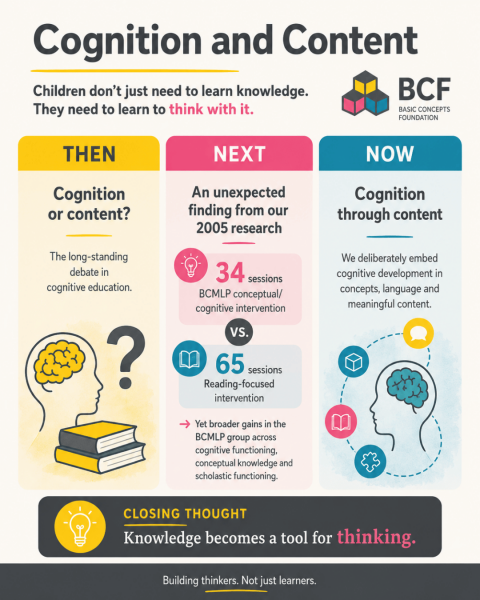
Cognition or content? Perhaps the most important answer is: both.
For decades, cognitive education has debated whether cognitive skills should be taught separately from academic content or embedded within children's everyday learning.
Our 2005 PhD research explored this question through an approach that deliberately combined conceptual knowledge with cognitive development.
One finding was particularly interesting. The Experimental Group received 34 sessions of BCP conceptual/cognitive intervention, while the Comparison Group received 65 sessions of reading and reading-related intervention. Despite receiving fewer sessions, the BCP group demonstrated a broader pattern of improvement across cognitive functioning, conceptual knowledge and scholastic functioning.
The takeaway is not that reading intervention is ineffective, nor that this research proves one approach superior to another.
Rather, it raises an important question:
What if the issue is not simply how much children are taught, but what they are doing cognitively while they are learning?
This thinking continues to shape the development of the Basic Concepts Programme.
We see cognition and content as complementary. Children need knowledge, but they also need to learn how to organise, compare, classify, relate and use that knowledge.
Because ultimately: Knowledge becomes a tool for thinking.